
Why we wrote this guide
The number one question Masterpiece Smiles gets about IV sedation is “will I be awake or asleep?” The honest answer is somewhere in between — and that’s exactly the point.
Dr. Robert Baumann was among the first dentists in Oklahoma City to offer in-office IV sedation. That history shapes how Masterpiece Smiles approaches sedation today. The doctors at Masterpiece Smiles who provide IV sedation are hospital-residency trained and IV sedation certified.
This guide answers the seven most common questions Masterpiece Smiles hears before, during, and after an IV sedation visit. If you’re considering sedation for yourself, a family member, or a patient with severe dental anxiety, this is what you need to know.
Question 1: Are you awake or asleep during IV sedation?
Short answer: you’re in a twilight state — relaxed, responsive, but with little to no memory of the visit.
IV sedation, sometimes called “twilight sedation,” puts a patient into a deeply relaxed state but does not make them unconscious. Patients can still respond to verbal requests from the dentist (“open a little wider,” “turn your head slightly”), can still breathe on their own, and still have their natural reflexes. What changes is the patient’s awareness of time, anxiety, and most patient memories of the actual procedure.
General anesthesia is a deeper state — the patient is fully unconscious — and is typically reserved for hospital-based surgical procedures. IV sedation at Masterpiece Smiles is in the moderate-to-deep conscious sedation range. Most patients describe the experience as taking a peaceful nap. Many remember almost nothing about the appointment after the IV starts working.
Practically: you’ll know you’re in the dental chair, you’ll be able to follow simple instructions, and you’ll feel calm in a way that’s hard to manufacture any other way. When the appointment is over, the last clear memory most patients have is the IV going in.
Question 2: How long does IV sedation take to start working?
Most patients feel the effect within 15 to 30 minutes of the IV being placed.
The onset is gradual rather than sudden. Once the IV line is placed and the medications begin flowing, patients typically describe a calm, drowsy feeling within the first 15 minutes. By 20 to 30 minutes, the sedation is at full working level and the dental work begins.
The medication dose is titrated to the patient — meaning Masterpiece Smiles’ doctors adjust the amount based on the patient’s response, weight, medical history, and the planned procedure length. A short visit needs less medication. A long restorative case needs the sedation maintained throughout.
Question 3: Will I feel pain during the dental work?
No. Local anesthetic is administered after the IV sedation begins, so the patient does not register the injection.
This is the part most patients underestimate. The combination of IV sedation plus local anesthetic means a patient does not feel the injection of the local — by the time the dentist administers it, the patient is already deep in sedation. The local then numbs the area being worked on, just like at any other dental appointment.
The result: the entire visit is pain-free, and patients typically have no memory of the injection that would normally be the most anxiety-inducing part of the visit. For patients with needle phobia specifically, this matters. The needle still happens — they just don’t remember it.
Question 4: How long does it take to recover?
Most patients feel sleepy for 1 to 2 hours after, with full clarity returning in 4 to 6 hours.
Recovery starts the moment the IV is removed. Patients are monitored in the office until they’re alert enough to be released to their designated driver. That’s typically 30 to 60 minutes after the dental work finishes.
For the rest of the day, plan to be sleepy and slow. A light meal once the patient feels hungry is fine. Driving is not allowed for 24 hours — a designated driver is required to bring the patient to the appointment and take them home. Most patients return to normal activities the morning after.
A reminder that often gets missed: arrange the driver before the appointment, not the day of. The same is true for help at home if the patient lives alone — having a friend or family member nearby for the rest of the day is recommended for any IV sedation visit at Masterpiece Smiles.
Question 5: Is IV sedation safe?
Yes, when administered by trained providers. The doctors at Masterpiece Smiles who provide IV sedation are hospital-residency trained.
Safety in IV sedation depends entirely on the training and protocols of the provider.
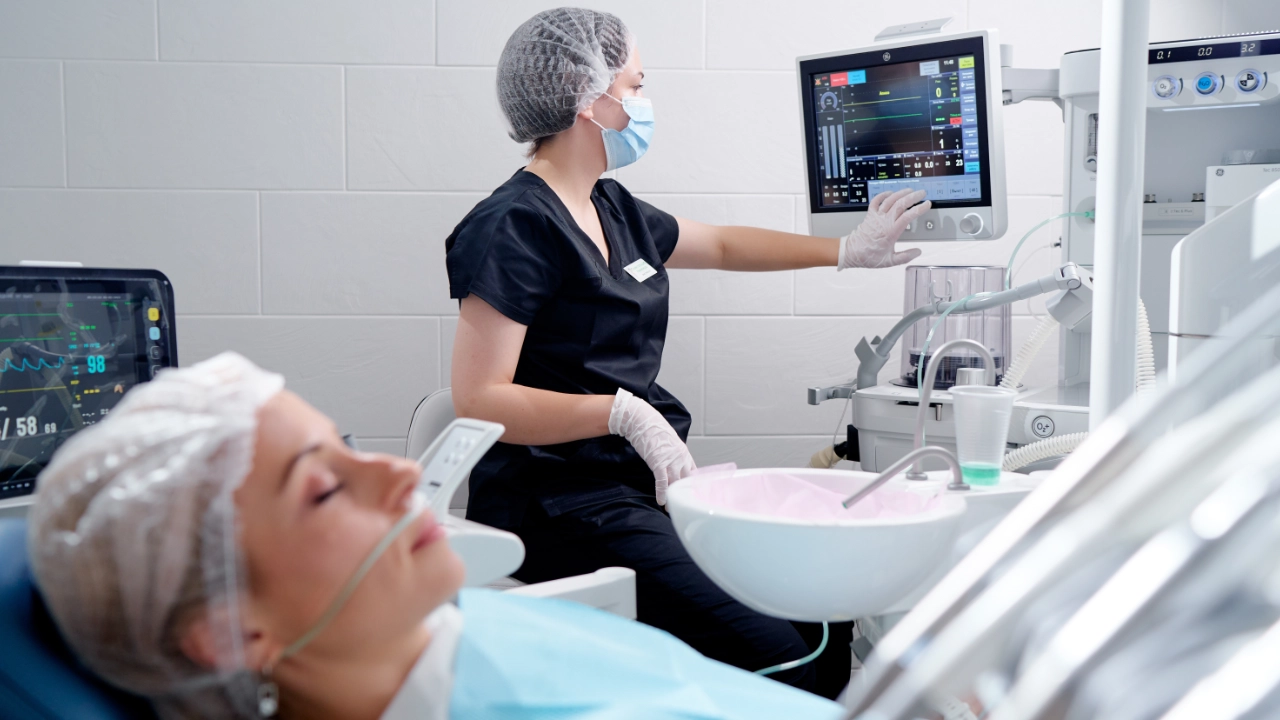
The doctors at Masterpiece Smiles who provide IV sedation completed hospital residency programs that included IV sedation training. Vital signs are monitored continuously during the procedure — heart rate, blood oxygen, blood pressure. Emergency protocols and reversal medications are on hand if needed.
Before any IV sedation visit, a pre-sedation medical review screens for conditions that need additional caution. Specific groups to flag during this review include patients with severe heart conditions, certain pulmonary conditions like advanced COPD, recent stroke history, sleep apnea (depending on severity), and patients on specific medications that interact with sedation drugs. None of these are automatic disqualifications — they’re conversations Masterpiece Smiles has with the patient’s other medical providers before scheduling.
Patients who are healthy adults with anxiety, dental phobia, gag reflex issues, or a need for multiple procedures in a single visit are the most common candidates and the lowest-risk profile.
Question 6: Who is a good candidate for IV sedation?
Severe dental anxiety, dental phobia, multiple procedures in one visit, gag reflex issues, and special needs adults who cannot otherwise tolerate care.
IV sedation is the deepest sedation option Masterpiece Smiles offers. The practice also offers nitrous oxide (laughing gas) and oral sedation for patients with milder anxiety. The right choice depends on the patient.
IV sedation is the right fit when:
- The patient has severe dental anxiety or full dental phobia and has been avoiding the dentist for years
- The patient had a traumatic past dental experience and needs to know they will not remember the visit
- Multiple procedures need to be combined into one visit to reduce the total number of appointments
- A pronounced gag reflex makes routine dental work difficult or impossible
- An adult special needs patient cannot tolerate dental care otherwise
For special needs adult care specifically, IV sedation is often the only path to comprehensive treatment. Masterpiece Smiles’ Special Needs Dental Care program pairs IV sedation with caregivers who can stay with the patient through the visit. For mild anxiety or short procedures, the Cavity Laser (Solea) often eliminates the need for sedation entirely because there’s no drill and no injection in most cases.
Children’s sedation is different and typically handled through pediatric-specific protocols. Masterpiece Smiles’ children’s dentistry team can walk a family through the right sedation choice for younger patients.
Question 7: How much does IV sedation cost?
Cost varies by procedure length and insurance coverage. The front desk verifies coverage before the visit so patients know the out-of-pocket cost up front.
There’s no single dollar figure that fits every IV sedation visit. The variables are procedure length (longer visits use more medication), insurance plan (some plans cover sedation when medically necessary; others do not), and what dental work is being done alongside the sedation.
The front desk verifies insurance coverage before every IV sedation visit. Financing options are available for patients whose insurance doesn’t cover sedation or who want to spread the payment. Call the practice with the procedure being planned and the patient’s insurance information for a verified estimate before the appointment.
How to decide if IV sedation is right for you
Three questions worth asking before booking:
- Has dental anxiety kept the patient out of the dentist’s chair for years, despite knowing dental work is needed?
- Does the patient have a phobia of needles, of the drill, or of the office environment itself — not just nervousness?
- Would treating multiple problems in one appointment, instead of spreading them over months, make care actually happen?
If the answer to any of those is yes, IV sedation is worth a conversation.
A 15-minute phone consultation is the easiest first step. Masterpiece Smiles can review the patient’s situation, walk through which sedation option fits best, and verify insurance before any appointment is scheduled.
Saturday hours are available for caregivers and patients whose weekday schedules don’t accommodate dental visits. Dr. Carmen Martinez provides Spanish-language care for Spanish-speaking patients and their caregivers, including caregivers of special needs adults.